Auditing a Perfume Factory's Claims: What to Ask For and What Proves Nothing
A folder of certificates proves that a management system was audited on a particular date, and almost nothing else. What separates a qualified fragrance manufacturer from a well-presented one is whether the documents match the site, the scope and the product category you are actually buying. This checklist covers the paperwork worth requesting, the two or three questions that expose rehearsed answers, and the limits of what a certificate can honestly tell you.
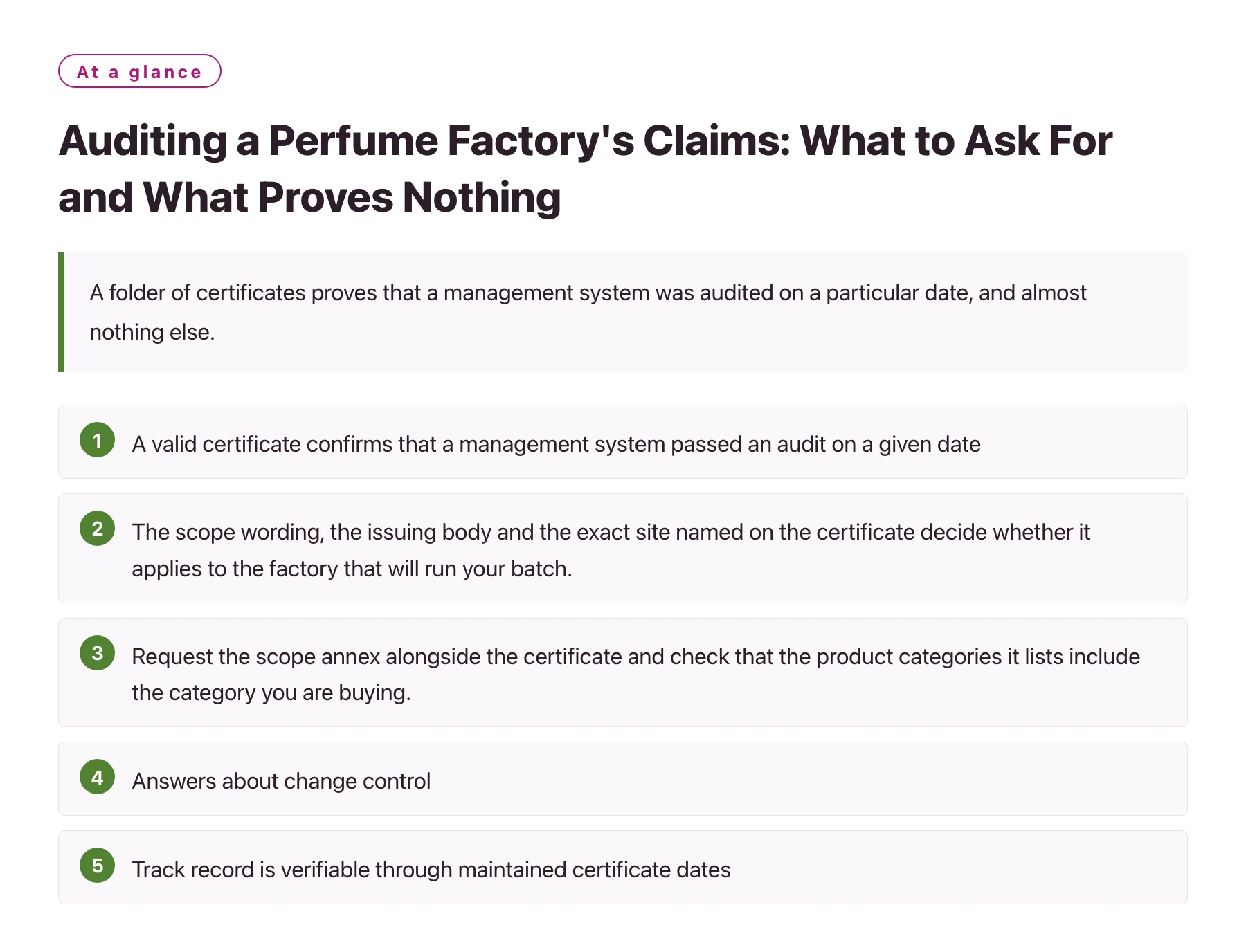
Key takeawaysA valid certificate confirms that a management system passed an audit on a given date, not that any particular product meets your specification. · The scope wording, the issuing body and the exact site named on the certificate decide whether it applies to the factory that will run your batch. · Request the scope annex alongside the certificate and check that the product categories it lists include the category you are buying. · Answers about change control, deviation handling and batch traceability reveal a factory's real discipline faster than any capability deck. · Track record is verifiable through maintained certificate dates, third-party test reports and repeat orders rather than through presentation material.
Most supplier shortlists are built from a capability deck and a price list. Both are marketing documents, and both are written to make a factory look organised. Qualification is a different exercise: it asks which parts of that picture can be verified, by whom, and against what evidence.
The gap between the two tends to show up late. A brand approves artwork, places a bulk order, and only then discovers that the testing regime described in the deck applied to a different product category, or that the certificate on file names a site that does not compound the formula.
This article works through the documents worth requesting, the follow-up questions that make a real difference, and the items that belong in a written supplier file before a quotation is even discussed. It assumes the supplier is honest but busy, and busy suppliers answer exactly the question you asked, which is why the question has to be precise.
What a management-system certificate actually proves
Certificates such as ISO 22716 for cosmetic good manufacturing practice, GMPC, ISO 9001 for quality management, ISO 14001 for environment and ISO 45001 for occupational health and safety are issued to a legal entity at a named site. They describe how that site is organised. They do not describe what comes out of it.
The distinction matters at the moment something goes wrong. A certificate gives you grounds for expecting documented procedures for deviations, corrective actions and traceability. It does not promise that those procedures were followed on your order, and it says nothing at all about how a fragrance performs.
Scope, site and validity dates
Read the scope paragraph before you read the logo. A certificate covering the manufacture of cosmetic products at one address does not automatically cover a second building, a subcontracted filling line, or a product family that sits outside the stated scope. That sentence is usually short and easy to find, and it is the one that decides whether the document is relevant to you.
Validity dates and surveillance cycles tell you whether the system is being maintained or has simply been bought once. A certificate that expired months ago and one reissued last month carry the same standard number and mean different things.
Who issued it, and how independent they are
Accreditation is the part buyers skip. Independent testing and inspection organisations audit cosmetic manufacturing sites against recognised GMP schemes and issue reports a buyer can act on, which is a different product from a certificate image pasted into a slide [1]. Ask which body performed the audit, under which accreditation, and whether the underlying report is available as well as the certificate.
If the only evidence offered is a low-resolution image with no issuing body details, treat it as an unverified claim for now and ask again in writing. A supplier that cannot locate its own audit report has told you something useful about its document control.
Certificates are process claims, not product claims
Nothing on a GMP certificate states that your formula is safe, that your label wording is compliant, or that your allergen declaration is complete. Those are product-level questions, answered by the safety assessment, the specification sheet and the test reports for the batch in question.
Confusing the two layers is the most common mistake in a first supplier review. It usually surfaces after artwork has been approved, when a late change to a declaration list means reprinting packaging and, in some markets, re-notifying a product.
Documents worth requesting before a site visit
| Document | What it tells you | What it leaves open |
|---|---|---|
| Certificates with scope annex | Which standards apply, to which legal entity and site, and until when | Whether the procedures were followed on your specific order |
| Third-party test report for a comparable product | How the factory documents microbiological, stability or heavy-metal testing | Whether the same regime will be applied to your formula |
| Allergen and restricted-material statement for a reference formula | How the factory handles declaration thresholds and fragrance use limits | Whether your own formula's materials will be checked to the same standard |
| Redacted batch record sample | The level of detail kept for compounding, filling and release | Nothing about cost or lead time, which are separate conversations |
| Site and equipment list | Which claimed processes exist in house and which are subcontracted | Actual condition, calibration and maintenance status |
Read the third column first. It decides which follow-up questions matter, and it is the column a supplier is least likely to volunteer. Any item on this list that cannot be produced within a reasonable time is itself a data point, and a more informative one than the item itself would have been.
A six-step remote qualification pass
- Fix the product category in writingState the exact category, whether fine fragrance, home fragrance or a scented body product, because scope statements and testing regimes differ between them.
- Match certificates to the siteCompare the address on the certificate with the address that will actually compound and fill your batch, and ask about any difference.
- Request one comparable test reportA report for a similar product shows the factory's documentation habits faster than any policy document it can send.
- Ask procedure questions with no easy answerFor example, what happens when a batch falls outside specification? A vague reply is more informative than a polished one.
- Check the restricted-material workflowAsk who reviews the formula against current use restrictions, how often, and what event triggers a reformulation review.
- Record the gaps and ask againSend a short written summary of open items and see whether the answers come back complete, on time and consistent with earlier statements.
Questions that separate policy from practice
Every qualified factory owns a quality manual. The interesting question is what happens when that manual meets a real problem, and the best way to find out is to ask open questions that cannot be answered with a yes.
Three areas repay the effort: change control, deviation handling, and the way the commercial relationship is documented. Each has a written answer and a practised answer, and they are rarely identical.
Change control and reformulation
Ask what happens when a raw material supplier changes a specification, or when a fragrance use restriction is revised. The International Fragrance Association maintains the standards that set how much of a given material may be used and in which product types, and those standards are updated periodically [2].
A factory that can describe its own trigger for a reformulation review, who checks it and what gets documented, is showing you a habit. One that answers that it always complies is showing you a slogan, and the difference becomes visible the first time a restriction changes mid-project.
Deviation handling and traceability
Ask how a deviation is recorded, who signs it off, and how the affected batch is identified downstream. Traceability from raw material lot to finished unit is the backbone of any recall decision, and it is either maintained as routine or reconstructed in a hurry.
Track record as evidence, not narrative
Industry associations publish guidance on how cosmetic products and their supply chains should be documented, which is genuinely useful when you draft your own supplier requirements [3]. Use it as a checklist for what your purchase order should demand rather than as a substitute for your own specification.
Track record belongs in the same section, and it should be evidence-shaped. Xuelei's 31 years in fragrance is the kind of claim a buyer can check against maintained certificate dates, third-party test reports and products already shipping, rather than against a presentation slide.
The temptation in a first qualification pass is to treat a folder of certificates as a green light and move straight to pricing. The folder proves that a system exists; it does not prove the system will be applied to your order. Spend one extra round on deviation handling, restricted-material review and change control before you ask for a quotation. The factories that answer those three well are usually the ones still answering emails when something goes wrong in production.
Sources
- SGS: Cosmetics, Personal Care & Household Testing —— Testing, inspection and certification services for cosmetics and personal care, including microbiological, stability and safety testing aligned with cosmetics GMP.
- International Fragrance Association (IFRA) —— IFRA is the global trade association of the fragrance industry; its site publishes the IFRA Standards, positions and science on the safe use of fragrance materials.
- Cosmetics Europe —— The European trade association for the cosmetics and personal care industry, publishing guidance, positions and market information.
Frequently asked questions
Do I need to visit a perfume factory before placing a first order?
Not always, but a remote pass has limits. Documents, a video walkthrough and one comparable test report can eliminate clearly unsuitable suppliers. A visit remains the only way to judge housekeeping, storage practice and how staff talk about deviations when nobody has prepared an answer.
Is ISO 22716 the same as GMPC?
They overlap but are not identical. ISO 22716 is the international guidance standard for good manufacturing practice in cosmetics. GMPC refers to a good manufacturing practice certificate issued against an equivalent scheme. Ask which standard, which version and which accredited body, then confirm the scope covers your product category.
Which certificate matters most for a fragrance brand?
For manufacturing, the cosmetic GMP certificate is the one that governs how your batch is made. Quality management certification supports it. Beyond that, relevance depends on your market and channel, so decide which claims you intend to make to customers and work backwards to the evidence you need.
Can a factory lose its certification?
Yes. Certificates are time-limited and depend on surveillance audits, so lapse happens through failed audits, missed surveillance or suspension. This is why validity dates and issuing body details matter as much as the standard number, and why a reissued certificate should be requested at each renewal.
What should a supplier qualification file contain?
At minimum: certificates with scope annexes, one comparable third-party test report, a redacted batch record sample, a restricted-material statement, a site and equipment list, and a short written summary of open items with the supplier's answers. Date every document so the file can be reviewed again next year.